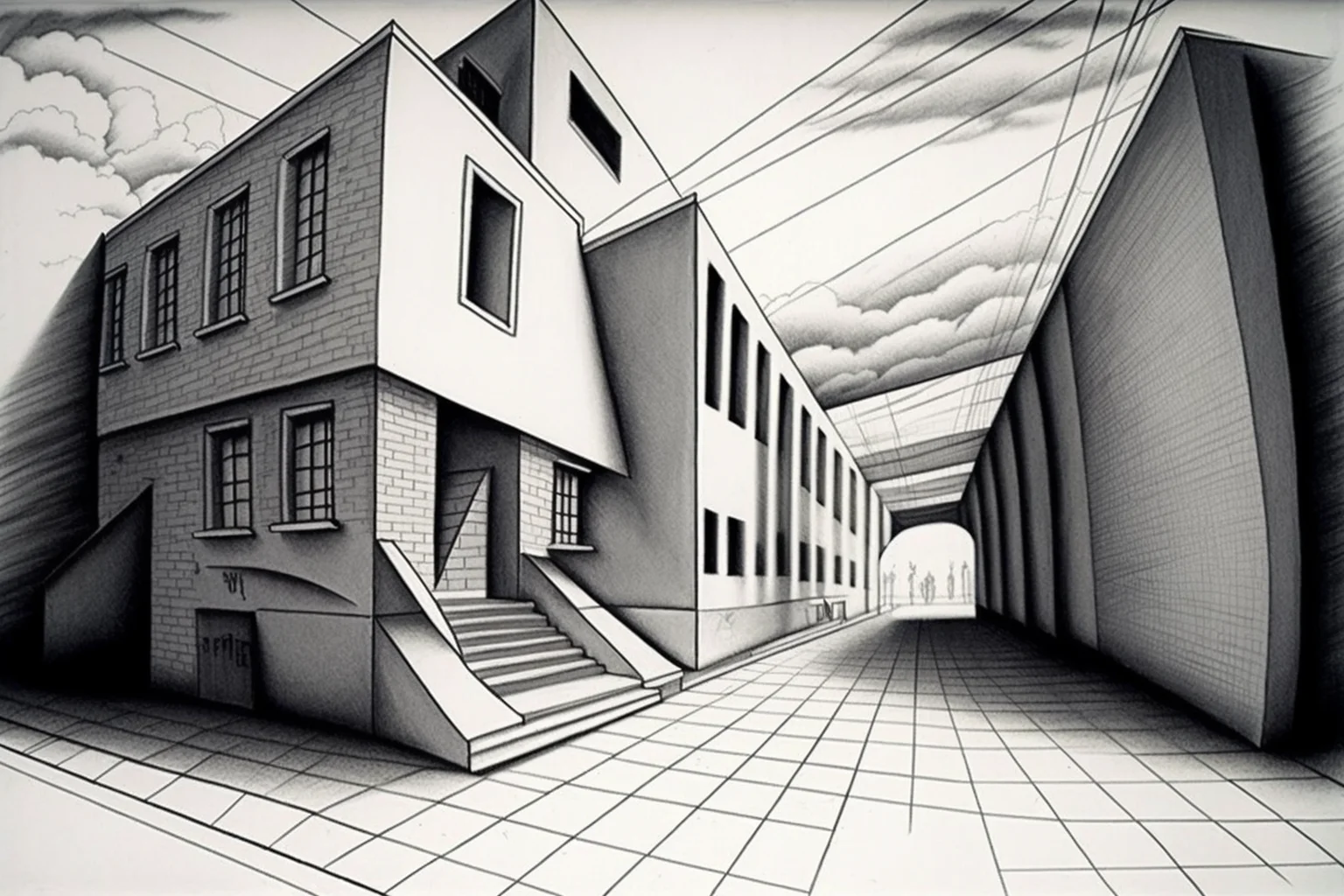
I'd like to talk for a moment about perspective.
When I was a young man, I had a very fixed vantage from which I saw practically the entire world. I saw whatever happened to be directly in front of me.
It burned me. The things that I hadn't considered, far outside of my vantage, would come back to haunt me. "You need to see the bigger picture," I was told, and so I began to build for myself an idea of what the bigger picture was, but more importantly, a reflex action of shifting my perspective between the high level, and then its application to the low level, and back. It assuaged a great deal of the fear of failure for me, and I taught it to others.
Now that I am no longer a young man, I begin to understand that even this shift in perspective is a lossy proposition. The larger view has only taught me how much of the smaller view there is to consider. The fear begins to return.
Pascal perhaps said it best in the Pensées:
What then is man in the midst of these two infinities? Nothing in comparison with the universe, infinite in comparison with the atomic. Since he is infinitely removed from comprehending the extremes, he is equally incapable of knowing the beginning and the end of things.
Even at our normal operating scale of thought, no matter how high level, nor how low level, there is an infinitely larger picture, and smaller. Even if we accept our high level as good enough, we must embrace the fact that this vantage is nothing more than an abstraction of more detailed viewpoints, each magnifying eventually into infinity.
How then do we avoid analysis paralysis? How can we consider ourselves competent to judge our understanding of anything, given that humbling precipice on which we stand? Socrates gives us a start in The Apology with:
Although I do not suppose that either of us knows anything really beautiful and good, I am better off than he is – for he knows nothing, and thinks he knows. I neither know nor think I know.
The relief that this has offered me is immediate. Even Socrates, perhaps one of the wisest men to ever live, experienced this doubt in the face of the unknown. And he tells us, thousands of years ago, that these terms are acceptable. I have learned to accept the impossibility of complete understanding, and in doing so, I've been able to change my working life quite dramatically.
I work in a complex field, enterprise class software. And that vantage between infinities has real world, very immediate consequences for me. We are constantly facing the incredibly complex rule sets that we've built over decades of learned experience, and we face a new world of speed with the use of Artificial Intelligence as a means to help us tame that complexity. But that is a double edged sword, and that uncertainty, problematic enough for humans, intensifies as AI, when left to run unchecked, takes ambiguities and turns them into feedback loops that magnify into large scale topology problems.
I've learned, and only recently, to accept my limitations, much as Socrates did, and to accept that the only way to navigate complexity is through conversation, exploration, and observation. I don't write code any longer; I negotiate with it, constantly applying those negotiations to the micro and macro level in real time.
The process is working. We recently performed a rewrite of a complex subsystem that would have been a year's work in two weeks, by shifting our vantage and approach from one of direct control to negotiation. It's a hard transition, and it depends on improving your sensory apparatus (testing, for one), which improves your observation. It requires iterative dialog to come to understand your reality, and that means conversation. And exploration... ah, that's life, isn't it, moment by moment, a slice at a time?
There is a joy to be found in accepting our inability to truly understand things completely, and William Blake expressed it well.
To see a World in a Grain of Sand
And a Heaven in a Wild Flower,
Hold Infinity in the palm of your hand
And Eternity in an hour.