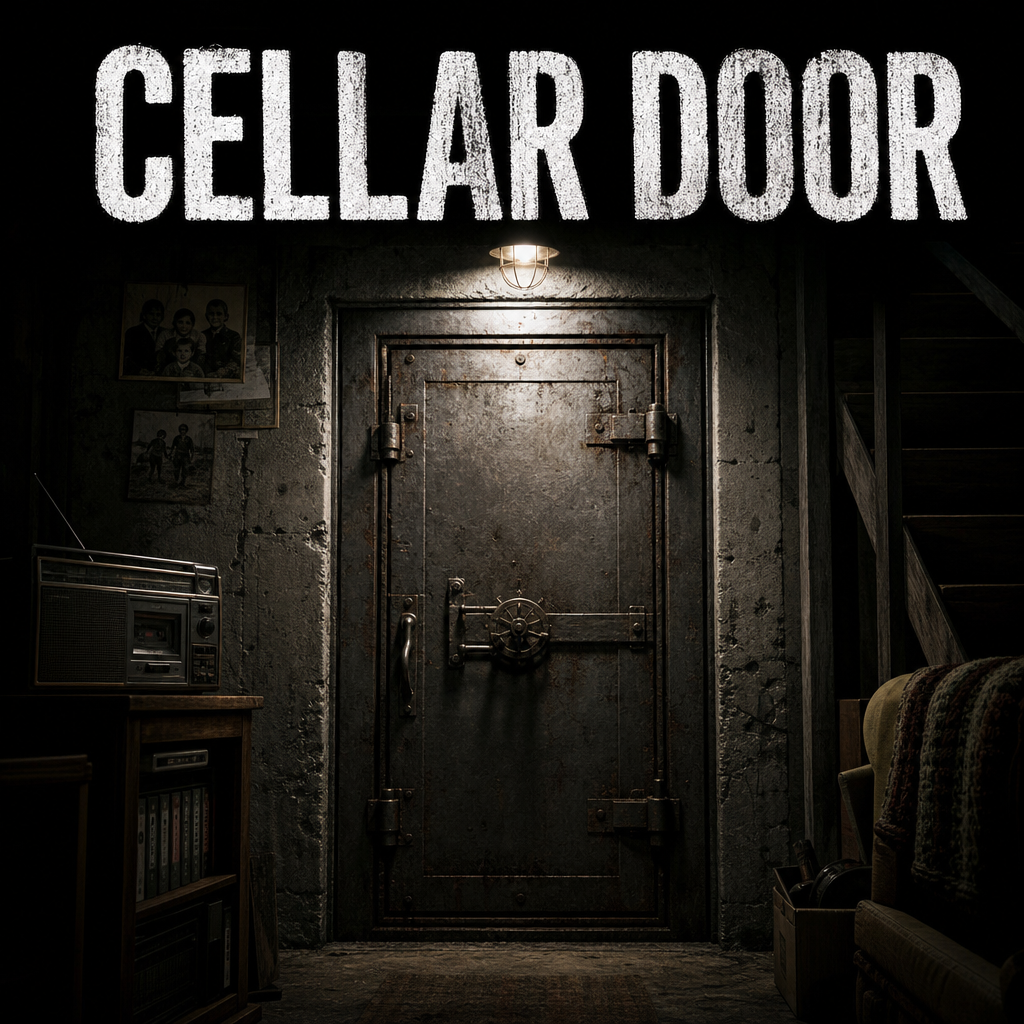
In my parents' house there stands a cellar door. It stood as a sentinel against which my life was measured. I refused to cross its threshold. And now, after their passing, I am presented with a dilemma which I cannot reconcile. I am frozen, trapped, fixated on my parent's cellar door.
You'd call them preppers now, my parents. In 1986, the term had yet to be coined, and so I had no words to describe the transformation of my life with them. At school, we'd have assignments to "write what you did last weekend," and I made up pleasantries. A fictitious camping trip was much easier to write than watching Red Dawn yet again on the VCR while my parents carted supplies into the stygian dark beneath our home. The 'facts of life' conversation I made up with my father had a better reception than the dinner talk, seated at the kitchen table with my back to that cellar door, hearing about how 'when the bombs fall, then and only then are you to head downstairs.'
I believed them, sometimes, those stories. The burn on my fingers came from an eager dig into a s'more, not from a hot cartridge case at the range. And it reconciled the questions about my folks at the sporting goods shop. And it explained away the reasons why I couldn't have friends over, nor why I couldn't bunk with them. Serious outdoorsmen, my parents were.
It was easier to say that, than to say that they were serious indoorsmen.
It wasn't easy, though, maintaining that lie. I can still remember begging the guidance counsellor not to call them. We'd been doing an air raid drill. "When the alarm sounds, you get under your desk and wait for the All Clear." So down we went like gophers down their holes, goofy expressions as they looked at each other from beneath their little forts.
But all that I could think of was that there would be no All Clear. Not for us. No, my father knew quite well how far we were from Ground Zero; he'd talked at length about it as we watched The Day After. On the screen, just after dinner, a man was dying of radiation poisoning, and Dad talked about how while the portrayal was accurate, it wouldn't take quite so long at our distance. "Close enough to die slow fast," he'd say, and remind me to stay close to home and listen for the Emergency Broadcast Signal, and then and only then, the door.
But here I was under this desk, and while the other kids were laughing, I couldn't stop crying, and it had taken creative fiction to keep from calling Dad. Dad might have understood. But he probably wouldn't.
I'll never know, now that he's gone. She's gone. There's just whatever is behind the door.
The radio is on. I can hear it, and nothing else. I don't hear George Orwell narrating "The Man Who Saw Tomorrow", narrating the certainty of armageddon as seen by Nostradamus in the 16th century. But then again, I never stopped hearing it. The tape is still in the shelf, just round the corner from this damned door.
And I could walk away. Yes, I could breeze past the hutch, past the tape cabinet, past the sofa, out the door, past the For Sale sign, and I could never think about it again.
But could I? I don't know what's down there. I couldn't ever look. I would flash to that sobbing moment under the desk, and remember how the guidance counsellor had excused me from being in class during the air raid drills, remember that I'd been afraid of crossing that door and coming apart again. I wanted to be Swayze in Red Dawn, bravely facing the end. But I was Lithgow in Day After, coming apart.
But couldn't I? What would the new owners, whomever they were going to be, think about whatever was down there? Would word get around? Would it get back to me?
And didn't I have to know? At long last, would knowing what they'd built change things?
I opened the door. Past the threshold, sturdy stairs descending into the dark. I'd been told the light switch was down there; stupid design, Dad. Stupid prepper. Stupid life.
I took the first step. And from the radio, I heard the Emergency Broadcast Tone.
There was never a thought, never a hesitation. I reached back and slammed that door shut.
And now, here I stand, in the pitch black. Did I really hear it? The door was built to withstand a blast; I can't hear a thing through it. I am frozen, trapped, fixated on my parent's cellar door.