No man who is corrupt, no man who condones corruption in others, can possibly do his duty by the community.
- Theodore Roosevelt
I sat before my terminal, and heard my eldest brother speak of the land grant.
So boring, my brother. But the priests never seem to mind. They never seem to mind anything.
I could return to matters of business; my township had a need of wool, and I had a contact from fifty miles over that had a surplus; I could smell the profits through the stink of wet wool, and I longed to strike an agreement, but citizenship demands a minimum attention to matters of state. Were I to fail to watch enough, I would lose my terminal outright, and that would destroy my business entire. Unacceptable.
"And so, dear Brethren," my brother said, "I would urge your decision to be that of acceptance."
"We agree. The motion passes; the land is to be surrendered by citizen Nathaniels for the good of the community.
"Before I adjourn this session let it be known that the Brethren debate regarding articles of conscription call to question in a week's time. Final hearing of your arguments should be made to your parish selectmen before that time. Preserve the peace."
The terminal darkened, and I leaned back, thinking deeply. Conscription. The idea had seemed laughable, only two weeks ago. And now..
I motioned to the terminal, and bought wool
I met my elder brother that evening at tha tavern.
"How fares the selectman?" I said as I sat at the table beside him, and motioned to the server.
"I'm well, Juran, thank you. And you?"
"Your best ale, young lady, and keep it coming until I tell you stop," I said to the comely maid with the tray, on which I spread coinage, "we're celebrating." She smiled, nodded, and bustled off.
"Well," said Thomas, "that answers my question."
"Indeed," I said, leaning back, "after intense negotiations, I've ensured our simple hamlet shall face the winter bravely."
"So the sheep master came through, did he?" Thomas asked.
"Faster than I expected," I said, "to our mutual benefit."
The maid placed our cups on the table; she was very fast, , and I expect she knew that the faster she watered us, the more of the coinage I'd dropped that she'd keep.
I lifted mine. Thomas looked slightly bitter as he took up his; I think he disliked how rarely I let him stand his rounds. No matter. I held my cup and toasted, "Bless the Brethren."
"And the peace," he said, and we drank.
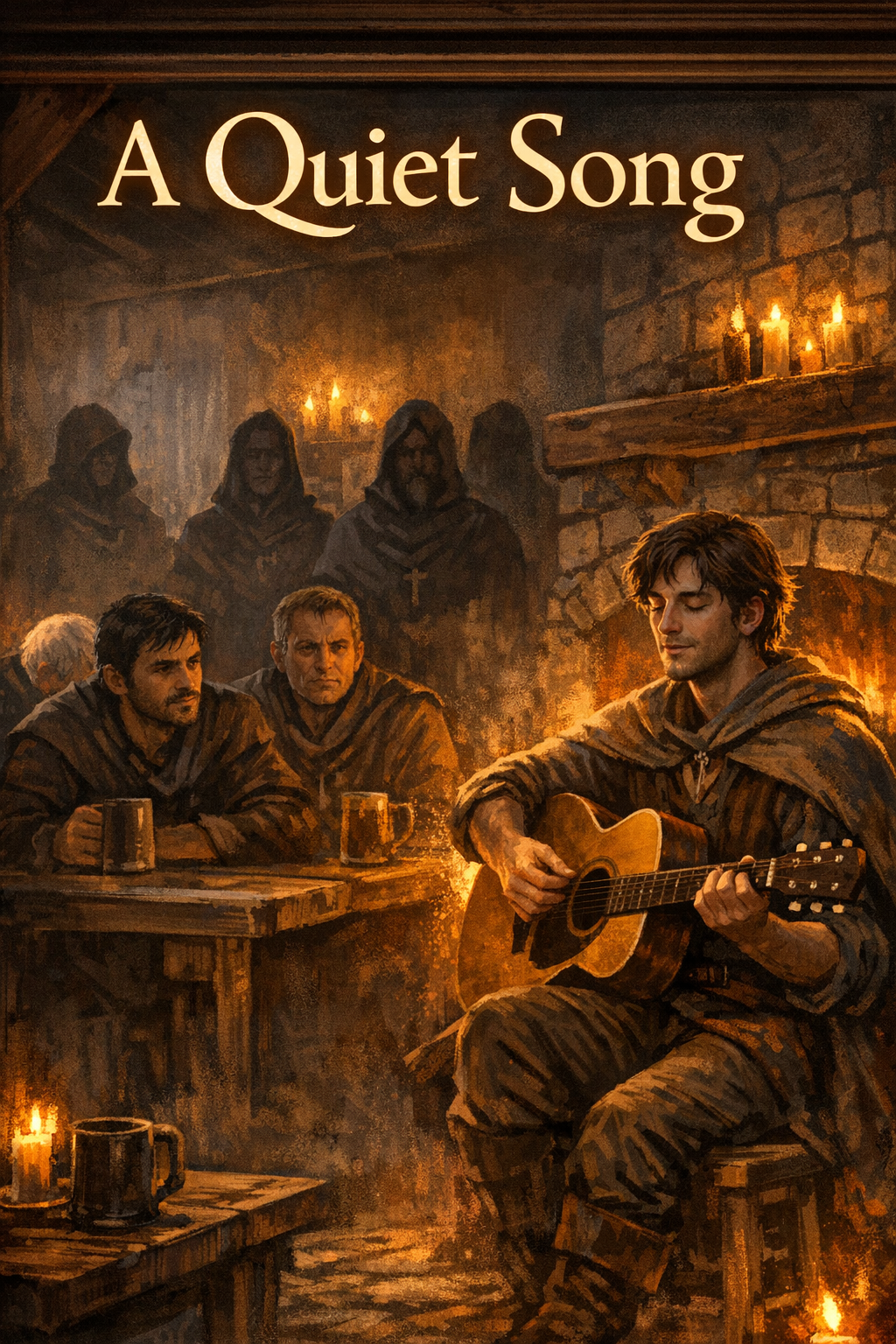
A stir of strings called our attention, and we turned to the small open space of floor before the fireplace, in which our brother, Parker, now sat, his guitar on his knee.
All conversation halted. No one ever spoke when Parker sang.
Of the three of us, he was the youngest, and his face, his voice, and his playing all fit his nature; he was joy incarnate, and yet his song was light, and low. He sang of simple things; of the wind cooling on a sunlit day, the stir of the leaves in canopy, the swish of skirts passing through tall grass. He sang of a predator lurking in the rough stalking it's prey, and brought the two images together like a punchline that even the barmaid smiled on.
Parker finished, and the tavern's population clapped and laughed. I turned back to Thomas, and found him somewhat less effected. "Won't you ever forgive him," I asked, drinking.
"There's nothing to forgive." he scowled.
"Isn't there? The ale's not sour enough to purse your lips, so why the face?"
"I won't pretend that I think him more capable than.. " he looked around, ".. this. But that's his concern. And yours, I think."
I rolled my eyes. "Parker makes his own decisions, Thomas. I've never urged him in any particular direction, and besides, I like it here."
"Aye, but I don't think he makes his way on what he earns here, now does he?"
"It's patronage, Thomas. The Brethren give us governance, and peace, but they've little lookout for our happiness. Parker is an investment worth making, to those that value such. Don't you?"
"Don't you what," Parker asked, pulling a chair to the table and sitting with us. The maid arrived instantly, and placed a cup before him. He smiled at her, and I don't believe he noticed how she nearly swooned. Then I thought back to his song, and reconsidered. Predator, indeed.
"Juran is holding lessons on the value of entertainment," said Thomas, watching the maid walk away.
"Ah, then I'm wasted here. My belief is that joy is worth it's weight in gold."
"So is brother merchant's, it seems." Thomas said.
"And are we not all grateful?" Parker said, casting his eyes round the room. The patrons met his eyes, and despite not hearing the question through the general din, proved his point regardless with smiles and nods. One table, however, did not look back. A dark cloud seemed to hang over it and it's sole occupant, and elderly man who slumped over the small table. Parker looked at him.
"Thomas, did the Brethren rule on Anderson's boy?" nodding at the old man.
"Aye, they did. He was found guilty, and will be inducted into the brethren tomorrow."
We held silent for a moment. We drank.
"How.." Parker started, and stopped. Thomas looked at him, a gentle frown.
"How will they do it?" Parker nodded. "They'll take him to the monastery of Saint Carlisle, bound and bitter. They'll strap him to a chair. They'll tear out a tiny part of his mind. And then they'll pour out his mind, and pour in a new one. And then he'll be a brethren judge."
"I still don't think that's possible," Parker said. "Surely something still remains. Some part of Francis Anderson will be there."
A few moments passed.
"There can't be," I said. "You know as well as any of us, people are corruptible. People cannot ever truly put the good of the community over their own. Sooner or later, everyone falls to temptation, and the world collapses into war, and death."
Thomas stared down into his cup. Of the two of us, it should have been him to say this, and I wondered why he hadn't.
"I get that," Parker said, "and that we depend on the selfless. I just don't believe, not even for a moment, that you can truly turn a person into.. into whatever it is that they become, and still be human. Are we really ruled by inhumans?"
"They are human," Thomas finally said, looking over at old Mr. Anderson. "They just want nothing for themselves, any longer."
"Isn't that what being human is?"
I thought for a moment. "I think.. "
Thomas interrupted. "No, brother mine, being human isn't just about base desires. We work to better ourselves, to override that nature. Anything else is descent into animal nature. The conversion is simply speeding the rule of mind over nature that we all seek."
"Oh," Parker said, "then why is the matter of conscription up to debate?"
I nearly spat my drink out. Perhaps Parker was paying more attention to civil discourse than I'd thought.
"We are victims of our own success," Thomas said, drawing himself up in his chair. "Crime is increasingly rare. Unwed births are rare. The Brethren have fewer orphans and criminals than ever with which to fill their ranks, and with so many parishes that need judgements, we must make up for the shortfall."
"Aye," said Parker, "yet if becoming one of them is such an aspirational goal, where are the volunteers? Would you join master Anderson on his ride tomorrow?"
"The parish needs an advocate to state cases, to speed their council sessions. They need someone who knows the people to speak for them. I am needed. And there are those that join the Brethren voluntarily."
"Truly," said Parker, looking back to the drunken old man. "I wonder if he will, soon."
"We are here to celebrate," I said, setting my cup down a little harder than I wanted.
"We shall, at that," said Parker, watching the maid approach. He stood as she approached, and said to us "I need to lift spirits," he said, "my own as well as anyone's." As he past the young lady, he leaned to her and spoke a few words quietly. She colored, leaning into him slightly as he stepped back to the stool by the fire and lifted his instrument.
He sang of rest, and of forgiveness, and I spoke to Thomas very quietly as watched old Anderson.
"That land grant this morning," I said, "it had your earmark, I think."
He grinned. "Aye, I think I spoke quite eloquently at the need for pastorage."
"Never a word of a wood mill beside your home, I note," I said.
"You aren't that far downwind yourself, brother mine." he said.
I nodded. "No, indeed not. It is sometimes useful to have an advocate in the family."
Parker played on, and I watched Anderson finally begin to sob, just as I knew Parker had intended. Mourning is a hard thing, but the hard things must be done.
Time can pass it spurts. An hour passed, and an old man was guided home by a young maid. Three brothers parted ways.
A week passed, and a last hearing held, in which Thomas offered no argument, and a resolution was decided.
A month later, and the first conscriptions were made.
A year passed, and another judgment of Brethren held. This was a physical session, and I had need to attend.
"I thank you, citizens, for your gracious welcome. As your local members of the Brethren, we resolve to serve you and your best interest.
"In that regard, I've reviewed past judgements, made in the general council of Brethren under more limited attention, and there are decisions which must be overturned. The first of such corrections is the matter of Nathaniel's loss of property. In studying your current pastorage, I see no reason why Citizen Nathaniel should be deprived of his property, and so I reverse that decision now, freeing him to enrich our community with a new mill."
And as the new brothers stood, their faces slack, their bodies wooden, I could absolutely swear that I could hear, very faintly, one of them, the one who'd last spoken, the one wearing Parker's face, humming. Humming a quiet song.